
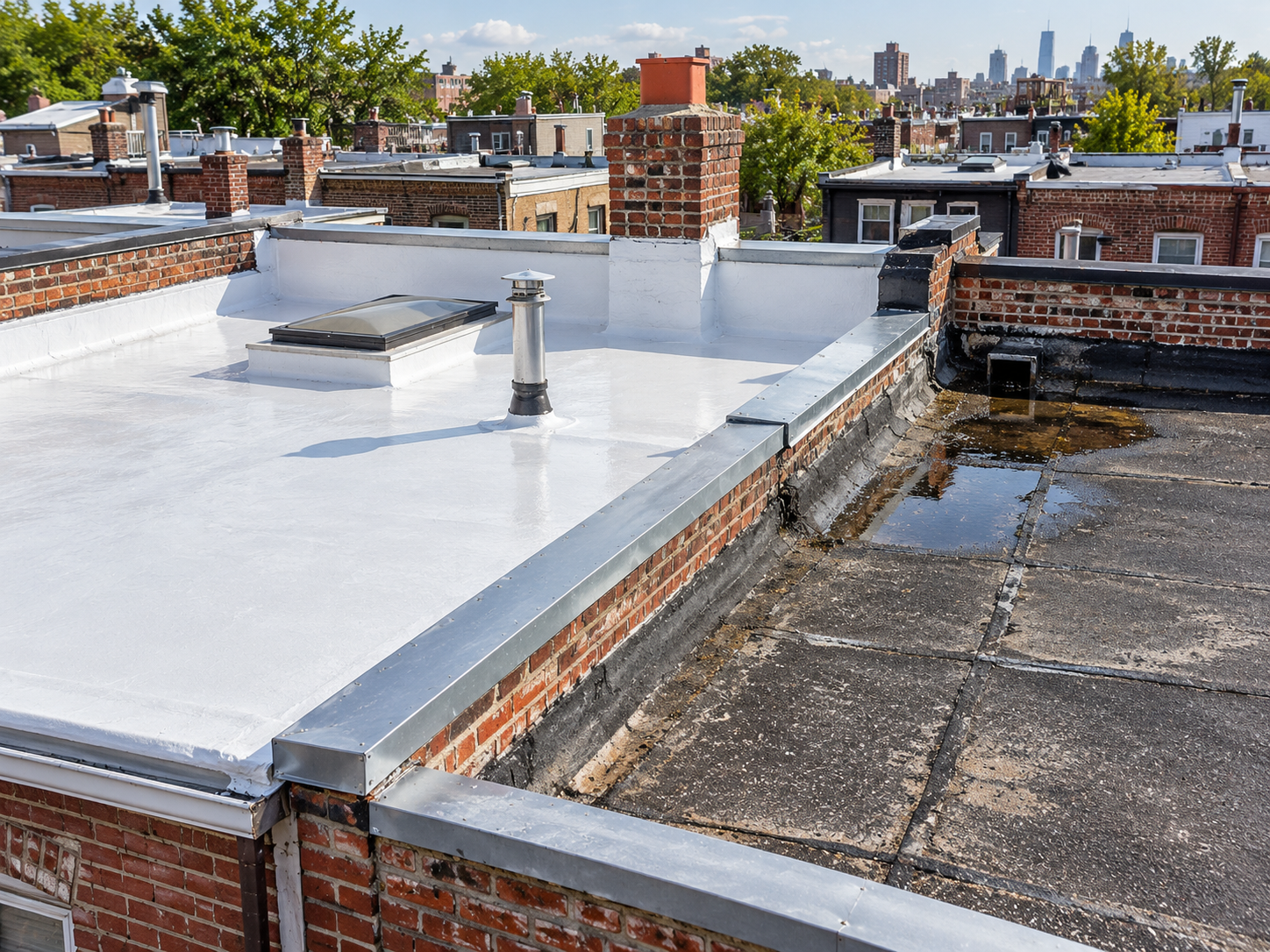
Most Philadelphia rowhomes have a low-slope roof: a membrane over a wood deck, bordered by parapet walls, draining toward a rear scupper or an interior drain. When that roof starts to show its age, homeowners usually hear about two very different paths. One is a liquid-applied coating over the existing roof. The other is a full replacement with a new membrane such as modified bitumen, EPDM, or TPO.
Both can be reasonable. The right answer depends less on the product and more on what is happening underneath the surface you can see. This guide explains what a coating actually does, the conditions where it makes sense, the conditions where it does not, and how replacement materials compare when a coating is not the right fit.
What a Roof Coating Is (and Is Not)
A roof coating is a liquid-applied layer, usually acrylic, silicone, or another elastomeric chemistry, that cures into a continuous film over an existing roof membrane. It adds a new weathering surface that takes ultraviolet exposure and, in light colors, reflects sunlight.
The Roof Coatings Manufacturers Association describes coatings as “restoration” and not a new roof system installation. The same page notes that long-term performance depends on proper preparation, repair of leaks or damaged areas, and selection of the correct primer and coating system. In other words, a coating is only as good as the roof it goes on.
What a coating does not do:
- It does not dry out wet insulation or a damp deck underneath.
- It does not fix a structural sag or a drain that sits at a high point.
- It does not replace failed flashing at parapets, chimneys, or curbs on its own. Those details must be repaired first.
When a Coating Can Be Enough
A coating tends to be a reasonable option when the existing roof is basically sound and the problems are on the surface. Signs that point in that direction:
- The membrane is still attached and flexible. It is aging, perhaps chalky or losing granules, but it is not brittle, cracked through, or widely blistered.
- Leaks are limited and traceable. Any active leaks have a clear source, such as a seam or a flashing detail, that can be repaired before coating.
- The insulation and deck are dry. This is the most important condition. Moisture trapped under a coating stays there.
- Drainage works. Water leaves the roof through the scupper or drain without long-standing ponds. Where some ponding is unavoidable, coating chemistry matters, because not every coating is formulated to sit under standing water. The manufacturer’s product data should state whether it is rated for ponding.
- The coating is compatible with the existing membrane. Manufacturers publish which substrates and primers their products are approved for. Compatibility with an older modified bitumen, an EPDM sheet, or a TPO membrane is not automatic.
If those conditions are met, a coating can extend the existing roof’s service without a tear-off.
When Replacement Is the Better Choice
Replacement becomes the more practical path when problems go deeper than the surface:
- Wet insulation or a soft deck. If moisture has reached the insulation or the wood deck, coating over it seals the moisture in. A tear-off lets the wet material come out and the deck be inspected. A core sample is how a roofer checks what is inside the assembly before deciding.
- Widespread membrane failure. Seams separating across the field, brittle material, or blisters over large areas are signs the membrane itself has reached the end of its useful life.
- Multiple existing layers. Many older rowhome roofs have been covered more than once.
- Repeated leaks at the same transitions. When parapet flashing, coping, or curb details keep failing, rebuilding them properly is often easier during a full replacement.
- Drainage that needs to be rebuilt. A scupper set too high, a drain without enough slope toward it, or a deck that has deflected over time cannot be corrected by a coating.
What Philadelphia’s Re-Roofing Standard Says
The City’s EZ Permit Standard for re-roofing is a useful reference for what local code expects when a new roof covering goes on. Among its requirements:
- All existing layers of roof covering must be removed first when the existing roof or covering is water-damaged or deteriorated, or when the existing roof already has two or more coverings.
- Planned replacement of sheathing in excess of 10% of the roof area is outside the EZ permit process, and damaged sheathing found during tear-off must be reported to the inspector.
- Roof coverings must be installed according to the manufacturer’s installation instructions, which must be submitted with the application.
- Any alteration to roof insulation must comply with the 2021 International Energy Conservation Code, with insulation of R-49 or greater listed on the standard.
- The roof must be certified by a licensed contractor as completed according to the manufacturer’s specifications.
- Properties listed as historic by the Philadelphia Historical Commission need prior approval before using the EZ process.
Those rules apply to new roof coverings. Whether a specific coating project needs a permit is a question to confirm with L&I for your property and scope.
Comparing Replacement Membranes for Rowhomes
When replacement is the right call, the three membranes most commonly discussed for Philadelphia rowhomes are modified bitumen, EPDM, and TPO. Each has strengths, and the best choice often depends on the roof’s details rather than the material alone.
Modified bitumen is an asphalt-based membrane installed in layers, either torch-applied, cold-applied, or self-adhered. It is familiar to most local roofers and adapts well to the many small details on rowhome roofs: parapets, chimneys, hatches, and pipe penetrations. Light-colored cap sheets or a factory or field-applied reflective surface can reduce heat gain.
EPDM is a synthetic rubber single-ply membrane, typically black, installed in large sheets with adhered seams. Fewer seams can be an advantage on simple, open roofs. Its dark surface absorbs heat unless a white version or a compatible coating is used.
TPO is a thermoplastic single-ply membrane, usually white, with heat-welded seams. Its reflective surface and welded seams are its main advantages. Detailing around many small penetrations and parapet transitions takes care and experience.
Replacement is also the moment to address insulation, deck repairs, drainage slope, and flashing, the details that usually decide how well a new roof performs.
Cool Roofs and Philadelphia Summers
Color and reflectivity are part of this decision too. ENERGY STAR explains that a cool roof stays cooler by reflecting sunlight (high solar reflectance) and releasing absorbed heat (high thermal emittance), and that cool roofs generally save the most energy in hot, sunny climates on buildings with low roof insulation. It also notes that energy savings in Northern climates are expected to grow as the climate warms.
Locally, the City’s Office of Sustainability ran a cool roof pilot in Strawberry Mansion, providing a reflective roof coating to 62 households starting in fall 2025. The City notes that some neighborhoods can be up to 30°F hotter than others because of fewer trees, more pavement, and dark roofs, and it plans to follow up on indoor temperature, energy use, and residents’ experiences after summer 2026.
For a homeowner, a light-colored surface is worth considering whether the roof is coated or replaced.
A Simple Decision Framework
Use these questions to sort the options before getting into product choices:
1. Is the insulation and deck dry? If not, replacement is the more practical path.
2. Is the membrane still flexible and attached? If it is brittle or widely blistered, coating will not change that.
3. Can every leak be traced and repaired first? If leaks are widespread or untraceable, the problem is likely below the surface.
4. Does water drain off the roof? If ponding is significant, confirm that the coating is rated for it, or plan to correct slope during a replacement.
5. How many layers are already on the roof? If there are two or more, the City’s re-roofing standard calls for removal before a new covering.
6. Is the coating compatible with the existing membrane? Ask for the manufacturer’s substrate approval.
Frequently Asked Questions
Can I coat my flat roof instead of replacing it?
Sometimes. A coating works best on a roof whose membrane is still sound, whose insulation and deck are dry, and whose leaks and flashing problems have been repaired first. It is not a fix for wet insulation or a failed membrane.
How can I tell if my roof is too far gone for a coating?
Widespread seam separation, brittle or cracked membrane, soft spots underfoot, repeated leaks from different areas, or multiple existing layers all suggest that replacement is the better path. Core samples or moisture testing can confirm what is inside.
Which is better for a rowhome: modified bitumen, EPDM, or TPO?
Each can work. Modified bitumen adapts well to the many small details on rowhome roofs, EPDM uses large sheets with fewer seams, and TPO offers a reflective surface and heat-welded seams. Roof details, drainage, and installer experience usually matter more than the label.
Do cool roof coatings make sense in Philadelphia?
They can. ENERGY STAR notes that reflective roofs stay cooler, and the City is testing reflective coatings on homes in Strawberry Mansion to measure indoor temperature and energy effects.
Do I need a permit?
Philadelphia publishes an EZ permit standard for installing new roof coverings on existing roofs. For a coating-only project, confirm permit requirements with L&I for your specific scope.
If you are trying to decide between coating and replacing your flat roof, Philly Roofing & Exterior Services can inspect the membrane, flashing, and drainage and explain which conditions apply to your roof. You can learn more about our flat roof replacement services in Philadelphia and request an inspection when you are ready.