
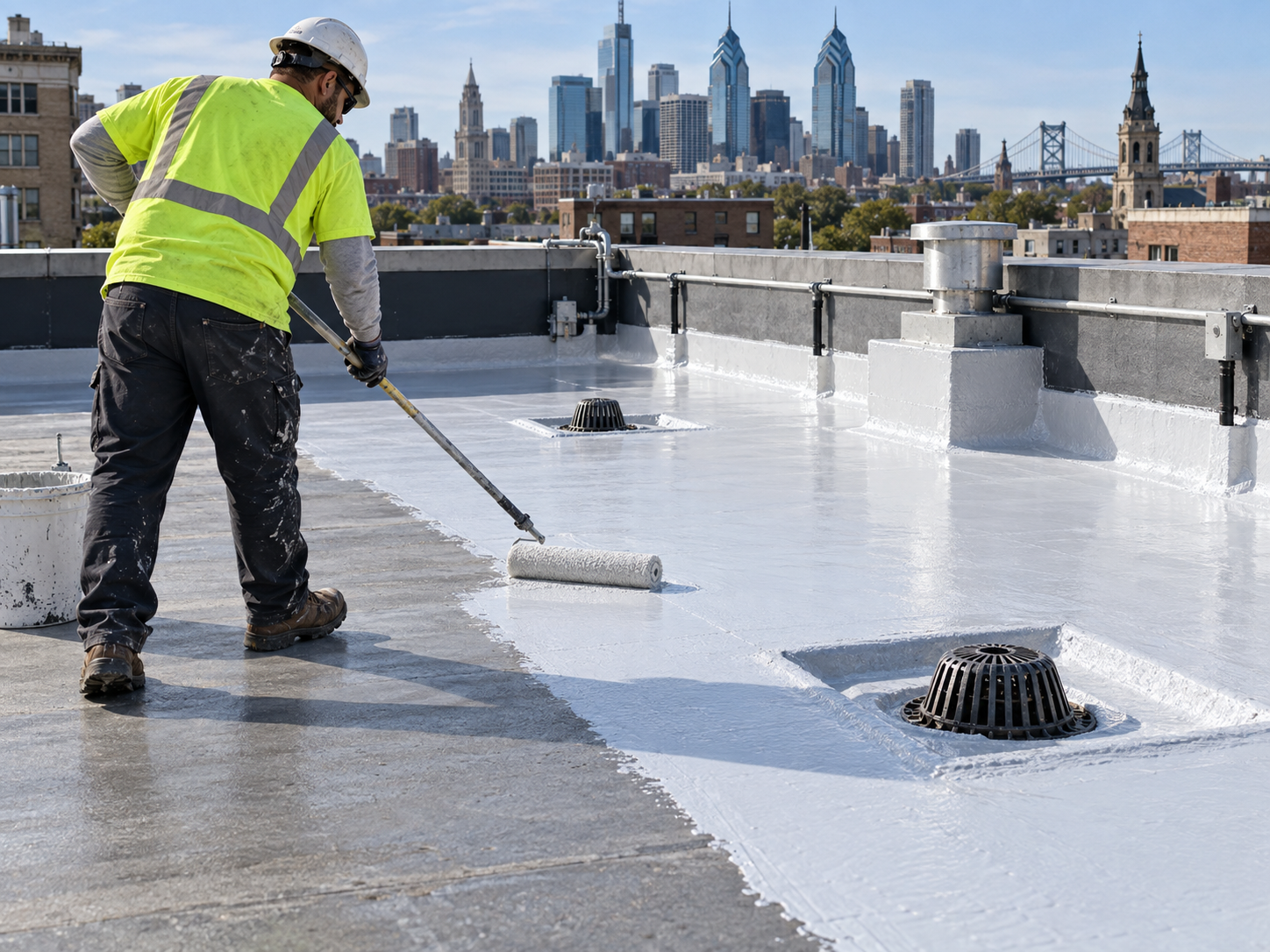
Flat Roof Repair vs. Replacement in Philadelphia: Making the Right DecisionMost historic and modern Philadelphia row-homes are topped with flat or low-slope roof assemblies. Because these roofs do not have the steep pitch of a suburban home, they cannot rely on gravity alone to shed water quickly. Instead, they depend on continuous, impermeable membrane systems and carefully graded drainage paths to keep water out.When a flat roof leaks, the water often travels laterally across the roof deck before dripping into your bedroom or kitchen, making the actual entry point difficult to find.
For homeowners, a leak triggers a stressful financial question: Can this roof be repaired, or is it time for a full replacement?At Philadelphia Roofing Experts, we focus strictly on honest, technical diagnostics. We never recommend a full replacement when a precise repair will work, and we never perform temporary surface patches on a structurally compromised roof assembly. Here is our technical guide to evaluating your flat roof.Evaluating the Condition of the Roof AssemblyA flat roof is not a single layer of material; it is a complex assembly.
Philadelphia Roofing Experts — official website.
Philadelphia L&I: Building Permits.
A typical modified bitumen (torch-down) or rubber roof system consists of the structural roof deck (wood or concrete), a vapor retarder, layers of rigid insulation, a protective cover board, and finally, the waterproofing membrane itself.Deciding between repair and replacement requires evaluating the entire assembly, not just the top layer.When Roof Repair is the Right ChoiceTargeted repairs are highly effective when the primary membrane is still in good condition (typically under 10-15 years old) but has suffered isolated, localized damage.
We frequently perform permanent repairs for the following issues:Punctures and Mechanical Damage: If an HVAC technician drops a tool or a falling tree branch pierces the membrane, the resulting puncture can usually be cleaned, primed, and permanently patched using compatible membrane materials.Isolated Seam Failures: Flat roofs are assembled in overlapping rolls. Over time, thermal expansion and contraction can cause isolated sections of the seams to open up.
If the rest of the roof is healthy, these seams can be heat-welded or sealed with professional-grade mastic.Flashing Defects: The most common source of a flat roof leak is not the main field of the roof, but the flashing—the metal transitions where the roof meets the parapet walls, skylights, or chimneys.
If the flashing has pulled away but the membrane is sound, replacing and resealing the flashing is the correct approach.When Full Roof Replacement is NecessaryA roof replacement (or full tear-off) becomes necessary when the membrane has reached the end of its chemical lifespan or when the underlying assembly is saturated with water.Alligatoring and Blistering: When a modified bitumen or asphalt-based roof ages, the UV radiation cooks the essential oils out of the material. The surface becomes brittle and develops deep, intersecting cracks resembling alligator skin.
At this stage, the membrane can no longer expand and contract; it is structurally dead and must be replaced.Saturated Insulation: If a roof has been leaking slowly for years, the rigid insulation boards underneath the membrane will become heavily saturated with water [1]. Wet insulation loses all its R-value (thermal resistance) and traps moisture against the wooden roof deck, leading to severe rot. We use core sampling and moisture scanning to determine if the insulation is saturated. If it is, a full tear-off is mandatory.
You can never simply roof over wet insulation.Widespread Ponding Water: If your roof holds large puddles of water for more than 48 hours after a rainstorm, the structural slope of the roof has failed. This often requires removing the existing roof to install tapered insulation, which artificially corrects the pitch and forces water toward the drains.The Danger of “Roofing Over” (Re-Covering)Philadelphia building codes allow for a maximum of two roofing layers on a property.
If you have a single existing layer, you may be tempted to simply install a new membrane directly over the old one to save money on demolition. This is known as a roof re-cover.While legal under specific circumstances, a re-cover is only viable if the original roof assembly is completely dry and securely attached to the roof deck. If moisture is trapped in the old roof, installing a new membrane on top will lock that moisture in, accelerating deck rot and often voiding the manufacturer’s warranty on the new materials.
Philadelphia Roofing Experts conducts rigorous moisture testing before ever recommending a re-cover.Choosing Your Replacement MaterialIf a replacement is required, selecting the right system for a Philadelphia row home is critical.Modified Bitumen (Torch-Down or Cold-Applied): A durable, multi-ply asphalt system reinforced with fiberglass or polyester. It handles heavy foot traffic well (important if you have a roof deck).TPO (Thermoplastic Polyolefin): A highly reflective, energy-efficient white membrane that is heat-welded at the seams.
It is excellent for reducing urban heat island effects and lowering summer cooling bills.EPDM (Ethylene Propylene Diene Terpolymer): A synthetic rubber membrane that is incredibly durable and resistant to UV rays. It is typically black, though white options are available.
FAQs About Flat Roof Repair vs
. ReplacementHow long does a flat roof last in Philadelphia?A properly installed modified bitumen roof typically lasts 15 to 20 years. Single-ply systems like TPO and EPDM can last 20 to 25 years with routine maintenance.Can I use a bucket of roof cement to fix a leak myself?We strongly advise against this. Over-the-counter asphalt roof cement (mastic) is a temporary stop-gap that quickly dries out and cracks under the sun.
Smearing tar over a leak often traps water underneath and makes the eventual professional repair much more difficult and expensive.Will my insurance cover a roof replacement?Standard homeowners insurance usually only covers a roof replacement if the damage was caused by a sudden, covered peril, such as a severe windstorm or a fallen tree. It does not cover replacement due to natural aging, wear and tear, or deferred maintenance.Don’t guess when it comes to the safety of your roof. For an honest, technical evaluation of your flat roof leak, contact Philadelphia Roofing Experts.
We will diagnose the exact failure point and provide a clear path forward.