
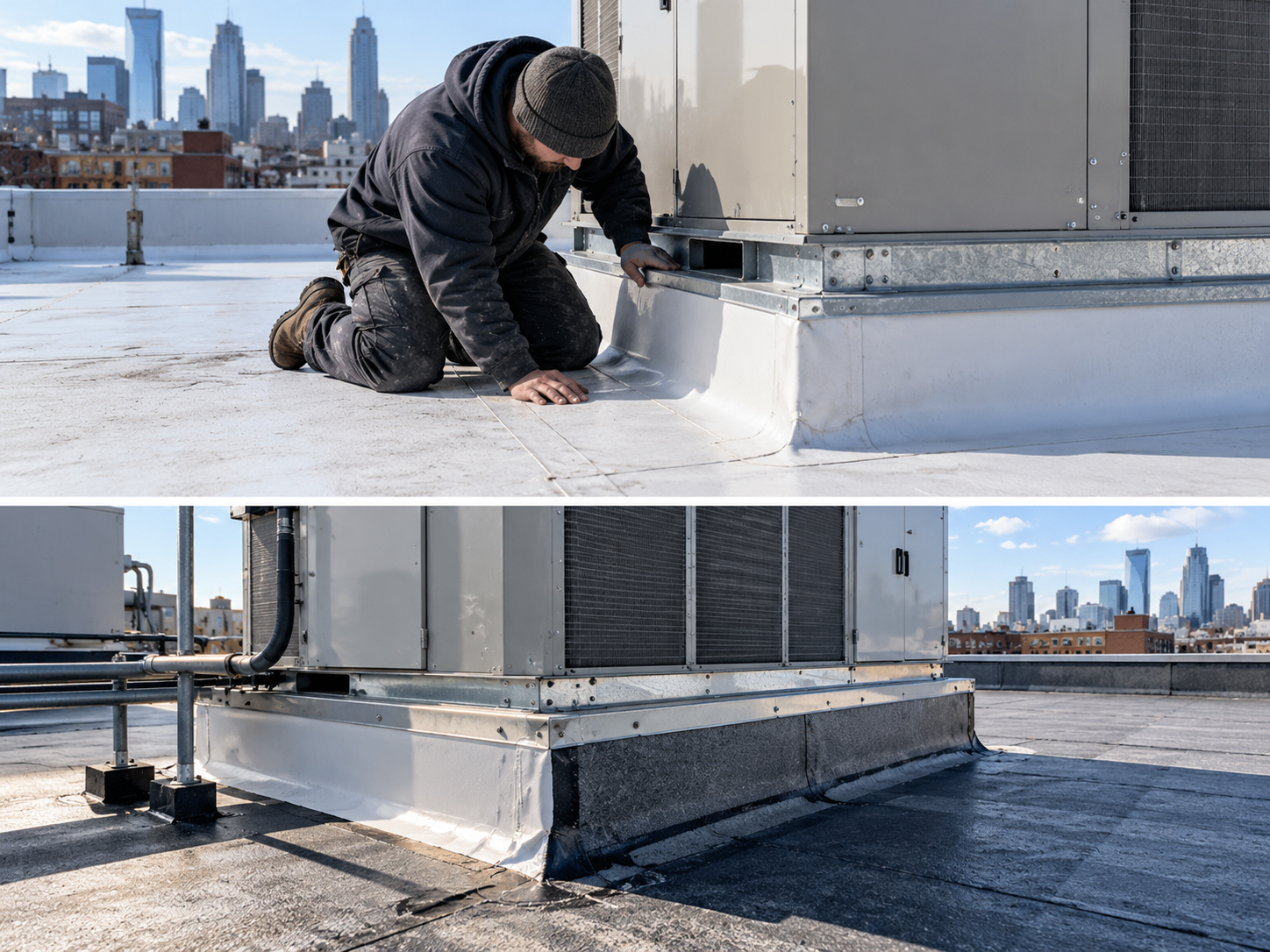
A commercial roof can perform well across thousands of square feet and still leak at one small mechanical penetration.
Rooftop HVAC units are common on Philadelphia commercial buildings, apartment properties, retail spaces, and mixed-use structures.
The equipment typically sits on a raised curb that connects the mechanical unit to the building while allowing the roofing system to transition around it.
That transition is a frequent inspection point when water appears near rooftop mechanical equipment.
What Is an HVAC Roof Curb?
A roof curb is a raised structural frame installed above the roof surface.
The HVAC unit attaches to the curb rather than sitting directly on the roofing membrane.
The roof system then has to integrate with the sides of that curb.
Depending on the assembly, this may involve membrane flashing, termination details, metal components, insulation, fasteners, sealants, and manufacturer-specific accessories.
Philly Roofing’s roof repair services include commercial and residential leak repairs involving roof transitions and penetrations.
Why Curb Areas Become Vulnerable
The roof around mechanical equipment experiences several stresses.
HVAC technicians may walk around the area repeatedly. Service panels are opened. Tools and parts are placed on the roof. Equipment vibrates. Sealants age. Roofing around corners can experience concentrated stress.
Water can also collect near the curb if drainage is poor.
None of these conditions automatically means the curb will leak, but they make the area worth inspecting carefully.
The Leak May Not Be the Roofing Membrane
Water near an HVAC unit can come from several sources.
The roof-to-curb flashing is one possibility.
Mechanical equipment itself may also produce condensation or contain drains and piping that leak.
Open service-panel joints, duct transitions, or other equipment components can sometimes introduce water above the roof flashing.
A roofing contractor should therefore avoid assuming that every ceiling stain below an HVAC unit is a membrane failure.
Corners Are Important
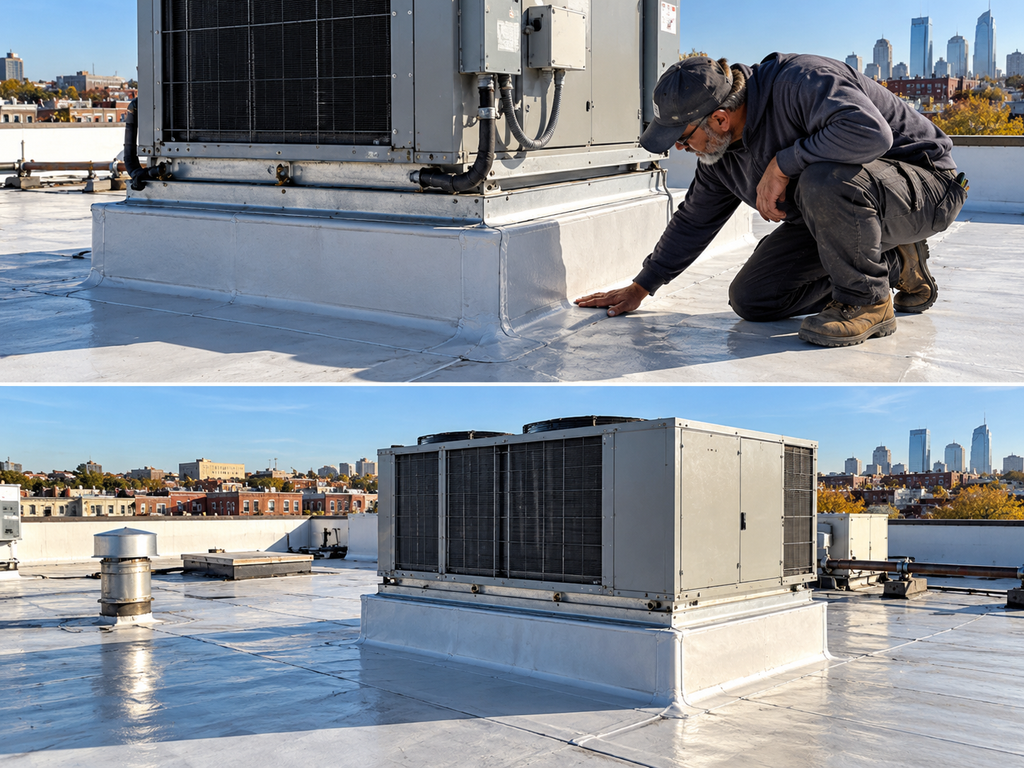
The corners of a raised curb require careful detailing because the membrane changes direction in multiple planes.
Poorly adhered patches, wrinkles, open laps, deteriorated corner reinforcement, or incompatible repair materials can create vulnerabilities.
Repeated surface patching without understanding the existing roof system may temporarily change the symptoms without correcting the root condition.
Height Above the Roof Surface Matters
Roof curbs should provide enough elevation to allow the roofing system and flashing to terminate correctly while remaining above normal water flow.
Existing buildings sometimes contain curbs that became effectively shorter after multiple roofing layers or insulation upgrades were added over time.
If a future re-roof raises the roof surface, curb height should be considered during planning.
Mechanical Work Can Affect Roofing
Roof leaks sometimes appear shortly after HVAC replacement or service work.
That does not necessarily mean the technician damaged the roof, but any work involving rooftop equipment should include protection of the surrounding membrane.
When an HVAC unit is replaced, the new equipment may not match the old curb exactly.
Adapters or curb modifications may be required.
Roofing and mechanical contractors should coordinate these transitions rather than treating them as independent work.
Drainage Around the Unit Should Remain Open
Leaves, packaging, filters, service debris, or roofing material can interfere with drainage paths around equipment.
Standing water against a curb increases the time the flashing remains exposed to moisture.
The broader roof drainage system should therefore be evaluated along with the local flashing condition.
Repairs Must Match the Roof System
TPO, EPDM, modified bitumen, built-up roofing, and other systems use different repair materials and techniques.
A generic bucket of roof coating is not a universal solution.
Repairs should be compatible with the existing membrane and installed according to the system’s requirements.
The National Roofing Contractors Association provides professional roofing resources covering roof-system practices and details.
FAQ
Does a leak under an HVAC unit always mean the curb flashing failed?
No. Equipment condensation, piping, duct-work, and other mechanical components can also leak.
Can curb flashing be repaired without replacing the roof?
Often, yes, when the surrounding roof remains serviceable.
Should HVAC contractors repair roof membranes?
Roof-system repairs are best coordinated with qualified roofing professionals familiar with the specific membrane.
Why did the leak appear after HVAC replacement?
Equipment changes can affect the curb, adapter, flashing, or surrounding roof area and should be inspected.
If water is appearing near rooftop mechanical equipment, Philadelphia Roofing Experts can inspect the curb, surrounding membrane, and drainage conditions to determine where the roof repair should begin.