
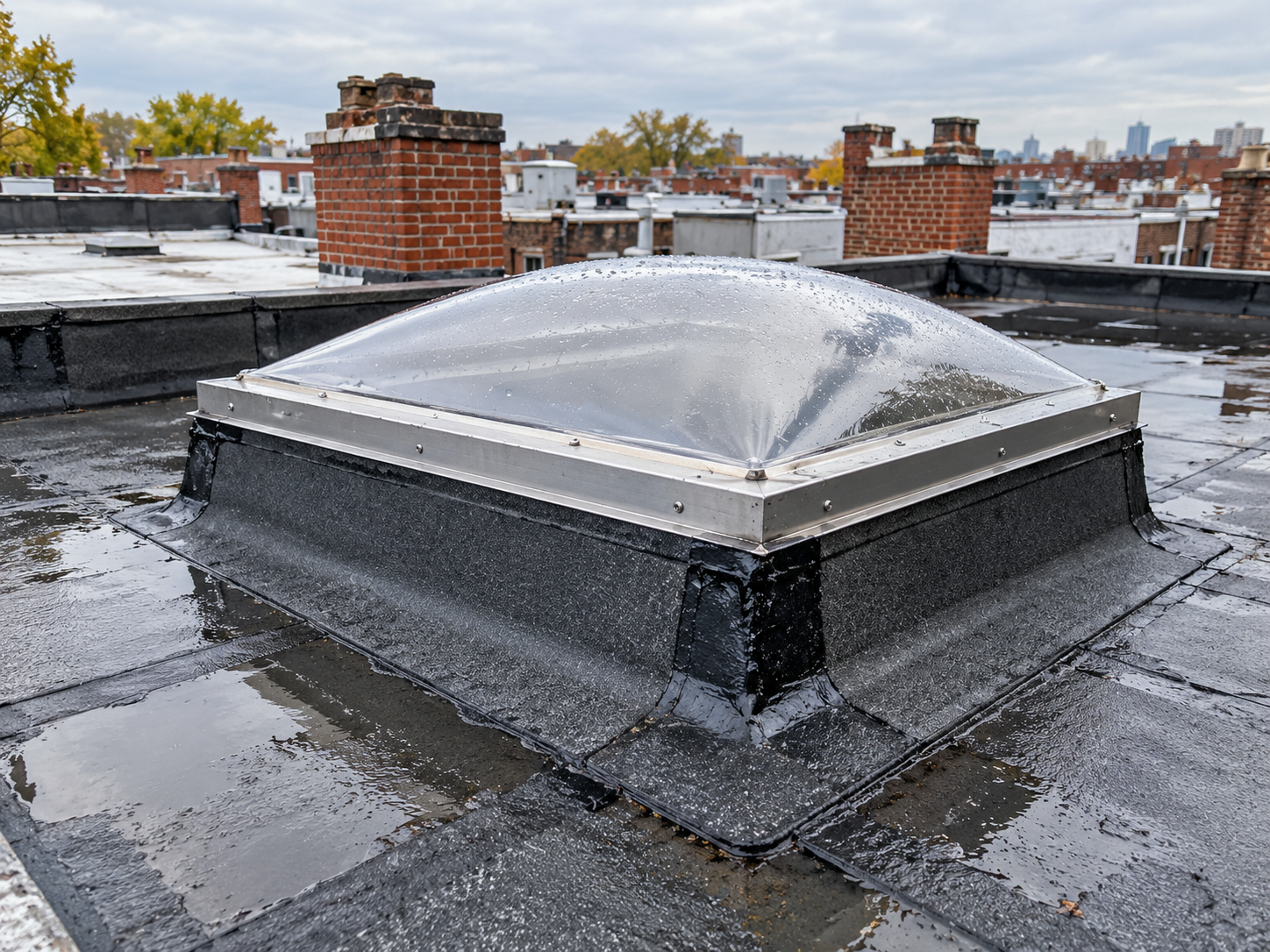
A water stain around a skylight is one of the most common top-floor complaints in Philadelphia row-homes. Skylights and roof hatches bring light into narrow houses in Fish-town, Queen Village and South Philadelphia, but every one of them is a large opening in a low-slope roof. When water shows up around the frame, it can be coming from several different places, and the fix depends entirely on which one.
This guide explains how skylights are built into flat roofs, how to tell a roof leak from condensation, where skylights typically fail, and when it makes sense to repair, replace or remove the unit.
How a Skylight Sits on a Flat Roof
On a sloped shingle roof, water runs past a skylight quickly. On a flat or low-slope roof, water moves slowly and can stand for hours after a storm. That is why skylights on flat roofs are normally mounted on a raised curb, a box frame that lifts the unit above the roof surface.
A typical flat-roof skylight assembly includes:
the curb: a wood or factory-made frame that raises the skylight above the roof surface and gives the roofing membrane something to turn up against.
•Base flashing: the roofing membrane carried up the sides of the curb and sealed, so water on the roof cannot get under the skylight.
the skylight unit: an acrylic dome, a glass unit, or an operable venting skylight, fastened to the top of the curb.
•Counter-flashing or the unit’s own flange: the skylight frame laps over the top of the base flashing to shed water.
the interior light well: the drywall or plaster shaft between the roof deck and the ceiling.
Skylight manufacturers publish curb height and flashing requirements for their products. Follow those instructions rather than general rules of thumb, because a curb that is too low can leave the joint between roof and skylight sitting in standing water.
Leak or Condensation? Check This First
Before anyone opens the roof, rule out condensation. In winter, warm, humid indoor air rises into the light well and meets the cold skylight surface. Water condenses, runs down the frame, and drips onto the ceiling. It looks exactly like a leak.
As ENERGY STAR explains, water condenses on interior window surfaces when the surface temperature is below the dew point of the indoor air. Skylights are especially exposed to this because warm air collects at the top of the house.
Clues that point to condensation:
•Water appears on cold mornings even when it has not rained.
droplets or frost are visible on the inside of the dome or glass.
the problem is worse after showers or cooking, or when a humidifier is running.
the stain is evenly distributed around the frame rather than in one corner.
Clues that point to a roof leak:
•Water appears during or shortly after rain, especially wind-driven rain.
•Staining is concentrated at one side or corner of the light well.
the roof around the curb shows cracked membrane, open seams or old coatings.
the problem happens in warm months too.
Some skylights have both problems. A single-layer acrylic dome is much colder on the inside than a modern insulated unit, so it condenses more, and older domes are also more likely to have failed seals.
Where Skylights on Flat Roofs Usually Fail
When the problem is a true leak, these are the places a roofer typically checks:
•Base flashing at the curb corners. Corners are the hardest place to seal and the first to open up. Membrane that was cut and patched rather than properly formed at the corners often fails here.
•Low curb height. If the curb barely rises above the roof, ponding water can reach the top of the flashing.
•Roof coating used instead of flashing. Silver or white coating painted up the curb may look sealed, but coatings crack at the transition and are not a substitute for membrane flashing.
•Deteriorated curb wood. A curb that has been wet for years can rot, loosening fasteners and letting the skylight shift.
•Cracked or crazed acrylic. Older acrylic domes become brittle with UV exposure and can crack, especially around the fasteners.
•Failed seals on glass units. Gaskets and sealant between the glass and the frame wear out over time.
•Ponding next to the skylight. A skylight placed in a low spot, or one that blocks drainage toward the scupper or drain, sits in water after every storm.
On row-homes, it is also common to find a skylight that was added during a past renovation with improvised curb framing or flashing. If the original installation was not built to the manufacturer’s details, repeated patching rarely solves it.
Repair Options: From Resealing to Removal
The right repair depends on the condition of the curb, the skylight and the surrounding roof.
Re-flash the curb
If the skylight unit is sound and the curb wood is solid, removing the old flashing and installing new base flashing that is properly formed at the corners is often the lasting fix. This is usually done with the same membrane type as the rest of the roof.
Replace the dome or unit
If the acrylic is cracked or the glass seals have failed, replacing the skylight unit, while keeping a sound curb, can stop the leak and reduce condensation if you choose an insulated unit. The replacement must match the curb size or the curb must be modified.
Rebuild the curb and skylight together
When the curb is rotted or too low, the most reliable approach is to remove the skylight, rebuild or replace the curb at the correct height, flash it into the roof, and install a new unit. This is often combined with roof repairs around the opening.
Replace the skylight during roof replacement
If the roof itself is near the end of its life, it is usually smarter to address the skylight as part of the roof replacement rather than flashing a new skylight into an old membrane.
Remove the skylight and deck over the opening
Some owners decide they would rather not maintain a skylight. The opening can be framed in, decked, insulated and roofed over. This removes the leak point entirely, though it gives up the daylight.
Skylights in Historic Districts
If your home is listed on the Philadelphia Register of Historic Places, roof work and visible rooftop elements are review items. According to the City of Philadelphia, project review is required for roofing and flashing work on listed properties. Replacing a skylight with a different size or style, or adding a new one, should be confirmed with the Historical Commission staff before work begins.
Frequently Asked Questions
Why does my skylight drip only in winter?
Drips that happen on cold, dry days are usually condensation. Lowering indoor humidity, running bathroom and kitchen fans, and improving air movement in the light well can help. If condensation is constant, an insulated replacement unit may be worth considering.
Can a skylight leak be fixed with sealant?
Sealant can be a temporary measure, but it rarely lasts on a flat roof where water stands against the curb. Lasting repairs usually involve proper membrane flashing or replacing failed components.
Should I replace my skylight when I replace my roof?
Often, yes. Flashing a new roof around an old, leaking or poorly curbed skylight leaves a weak point in an otherwise new system.
Is a roof hatch handled the same way?
Roof hatches also sit on curbs and use similar flashing details, so many of the same failure points apply.
Get the Cause Right First
A skylight leak repair that targets the wrong cause wastes time and money. Separating condensation from roof leaks, then inspecting the curb, flashing and unit, leads to a repair that matches the actual problem.
Philly Roofing & Exterior Services inspects and repairs skylights and skylight flashing on flat and low-slope roofs. See our skylight services to schedule an inspection.