
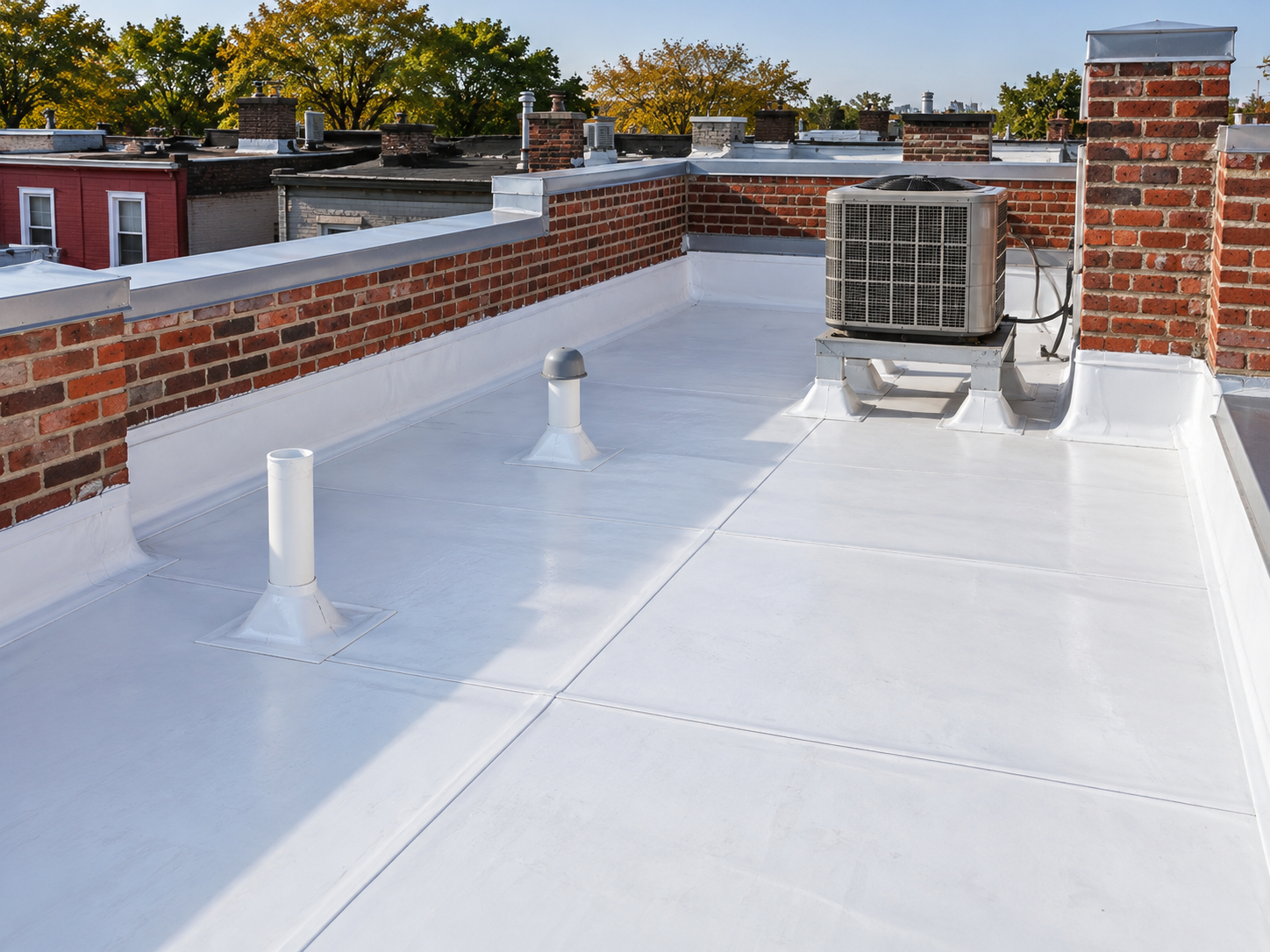
Most Philadelphia rowhomes have a low-slope roof hidden behind a brick parapet. Over the decades those roofs have been covered with built-up tar and gravel, modified bitumen, rubber (EPDM), coatings and, more recently, single-ply thermoplastic membranes such as TPO and PVC. When it is time to replace a worn-out flat roof, many owners hear PVC mentioned and want to know whether it is a good fit for their house.
This guide explains what PVC roofing is, how it is installed on a typical rowhome, where it performs well, and the questions to ask before you choose it.
What a PVC Roof Is
PVC roofing is a single-ply membrane made of flexible polyvinyl chloride reinforced with a fabric scrim or mat. It comes in rolls, usually in white or light gray, and is fastened or adhered over insulation and a cover board on the roof deck.
The feature that sets PVC apart is how the seams are joined. The trade association for the material explains in Vinylroofs.org’s overview of PVC durability that PVC seams are fused with hot air, forming a watertight bond that is stronger than the membrane itself, without solvent adhesives, torches or open flames. The same source notes that PVC membranes are designed to stay watertight under constant dampness and ponding water.
On a rowhome, that matters because most leaks start at seams, edges and penetrations, not in the middle of the field.
Why Rowhome Roofs Are a Special Case
A Philadelphia rowhome roof is small, but it has a lot going on for its size:
- Brick parapets on the front and sides, often with shared walls between neighbors.
- A rear edge with a gutter or scupper and a downspout.
- Plumbing vents, an old chimney or two, and sometimes a skylight or roof hatch.
- HVAC condensers or mini-split units on stands.
- Low spots where water ponds after a storm.
- Neighboring roofs at slightly different heights.
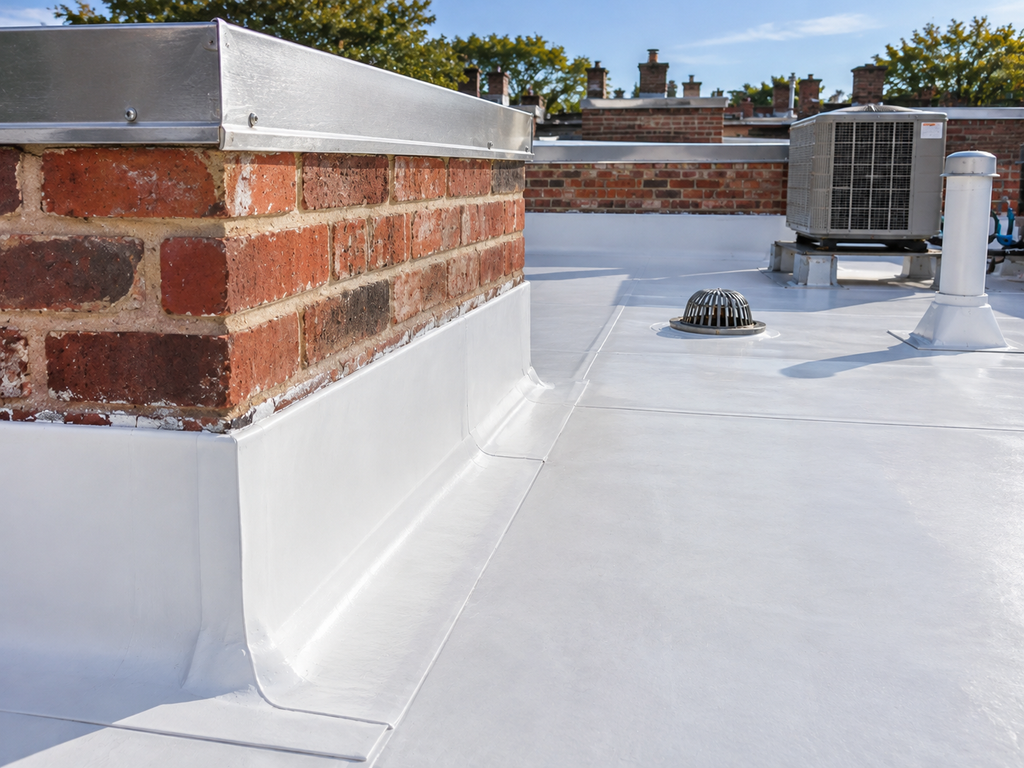
Every one of those details needs to be flashed. A membrane that can be heat-welded at corners, curbs and wall transitions gives the roofer a consistent way to seal them.
How a PVC Roof Is Typically Installed on a Rowhome
Every roof is different, but a typical PVC replacement on a rowhome follows these steps:
1. Inspect the existing roof, the deck and the parapets, and check for trapped water in the old layers.
2. Tear off the old roofing down to the deck when layers are wet, too many or failing.
3. Repair or replace soft or rotted decking.
4. Install insulation, often tapered to move water toward the drain, gutter or scupper.
5. Install a cover board and fasten or adhere the PVC membrane.
6. Heat-weld all seams and probe them for gaps.
7. Flash parapets, curbs, vents and skylights with PVC flashing and termination bars.
8. Finish the parapet with coping or cap flashing and reconnect gutters and downspouts.
On an occupied home, the crew also has to plan for weather windows, debris removal through a narrow street and protection of the interior if the deck is opened.
Where PVC Works Well
PVC is a strong option for several common rowhome situations:
- Roofs with ponding water that cannot be fully eliminated by tapering.
- Roofs with many penetrations and transitions, where welded flashings simplify detailing.
- Roofs near restaurant exhaust or grease, since PVC is often chosen for chemical resistance. Confirm compatibility with the manufacturer for your exact conditions.
- Owners who want a light-colored, reflective surface to reduce heat gain on the top floor.
- Roofs under a deck, where the membrane must be protected with sleepers or pedestals.
PVC Compared With Other Flat Roof Options
Owners often compare PVC with TPO, EPDM and modified bitumen. A simple way to frame the decision:
- PVC: heat-welded seams, good chemical resistance, light color, usually priced higher than TPO.
- TPO: also heat-welded and light colored, often lower in cost, and widely used on rowhomes.
- EPDM (rubber): proven and flexible, but seams rely on tape or adhesive.
- Modified bitumen: multiple layers and a granular surface, durable under foot traffic, with seams sealed by heat or adhesive.
There is no single best membrane for every house. Your roofer should explain why one system fits your roof’s slope, drainage, penetrations, budget and plans for a deck or solar.
Questions to Ask Before You Choose PVC
- Will the old roof be torn off or covered, and why?
- What insulation and cover board will be used, and will it be tapered?
- How will the parapet walls, coping and neighbor tie-ins be detailed?
- How are seams tested after welding?
- Which manufacturer’s membrane will be used, and what thickness?
- What warranty does the manufacturer offer, and what does it require?
- How will HVAC stands, vents and skylights be flashed?
- What maintenance does the roof need each year?
Get the answers in writing as part of the proposal so you can compare bids on the same scope.
Maintenance and Repairs
A PVC roof still needs attention. Check it in the spring and fall, after big storms, and whenever work is done on HVAC equipment or the chimney. Keep gutters and scuppers clear and watch for punctures from dropped tools or debris.
One practical benefit of thermoplastic membranes is that many repairs can be heat-welded with a matching patch, as long as the membrane is clean and still in good condition. A roofer familiar with PVC should handle those repairs, since the wrong sealant or patch material may not bond.
Signs Your Current Flat Roof Needs Attention
- Water stains on the top-floor ceiling, especially after heavy rain.
- Blisters, cracks or open seams in the existing roofing.
- Standing water that stays more than a day or two.
- Soft spots when walking on the roof.
- Loose or cracked parapet flashing or coping.
If you see these signs, have the roof inspected before choosing a system. Sometimes a repair is enough. Sometimes the roof needs to be replaced.
Planning Around Roof Decks, Solar and Equipment
Many rowhome owners want more from the roof than protection. Roof decks, solar panels and new HVAC equipment all sit on top of the membrane, so the time to plan them is before the new roof goes on, not after.
- Roof decks: a deck should not bear directly on the membrane in a way that crushes insulation or blocks drainage. Common approaches use sleepers on protection pads or adjustable pedestals, with a walkway pad or extra membrane layer beneath. Ask how the deck structure will be anchored and how its posts will be flashed if they pass through the roof.
- Solar: racking systems may be ballasted or attached. Attached systems need flashed penetrations that are compatible with PVC. Coordinate the layout so seams and flashings are not hidden under panels.
- HVAC equipment: condensers and mini-split units are best set on raised stands with flashed legs or on curbs, with service clearance around them. Line sets should enter through a properly flashed penetration, not through a hole sealed with caulk.
- Walk paths: if equipment needs regular service, walkway pads protect the membrane from foot traffic.
It is also worth asking about the roof edge at the back of the house. Many rowhome roofs drain to a rear gutter or a scupper through the parapet. With PVC, edge metal and scupper liners can be clad or flashed so the membrane welds directly to them. That detail is where many older roofs leaked first, so it deserves attention in the proposal.
Finally, think about your neighbors. Rowhome roofs meet at shared parapets or at lap joints with the next roof. A good installer explains how the new PVC will tie into the adjacent roof without depending on the neighbor’s material, and how that joint will be inspected over time.
Frequently Asked Questions
Is PVC a good choice for a flat roof in Philadelphia? It can be, especially on roofs with ponding, many penetrations or exposure to exhaust. The right choice depends on your roof’s conditions and budget.
How long does a PVC roof last? Service life depends on the membrane, the installation, drainage and maintenance. Ask for the manufacturer’s warranty terms in writing.
Can a PVC roof be repaired? Yes. Many repairs can be done by heat-welding a matching patch onto clean, sound membrane.
Is PVC better than TPO? Both are heat-welded single-ply membranes. PVC is often chosen for chemical resistance; TPO is often lower in cost. Your roofer should explain which fits your roof.
Can I put a roof deck over a PVC roof? Often yes, with a deck design that protects the membrane and keeps drainage working. Plan it before the roof is installed.
If your rowhome roof is leaking, ponding or simply at the end of its life, Philly Roofing & Exterior Services can inspect it and explain your options, including PVC. Learn more about our flat roof repair and installation services in Philadelphia and schedule an inspection.