
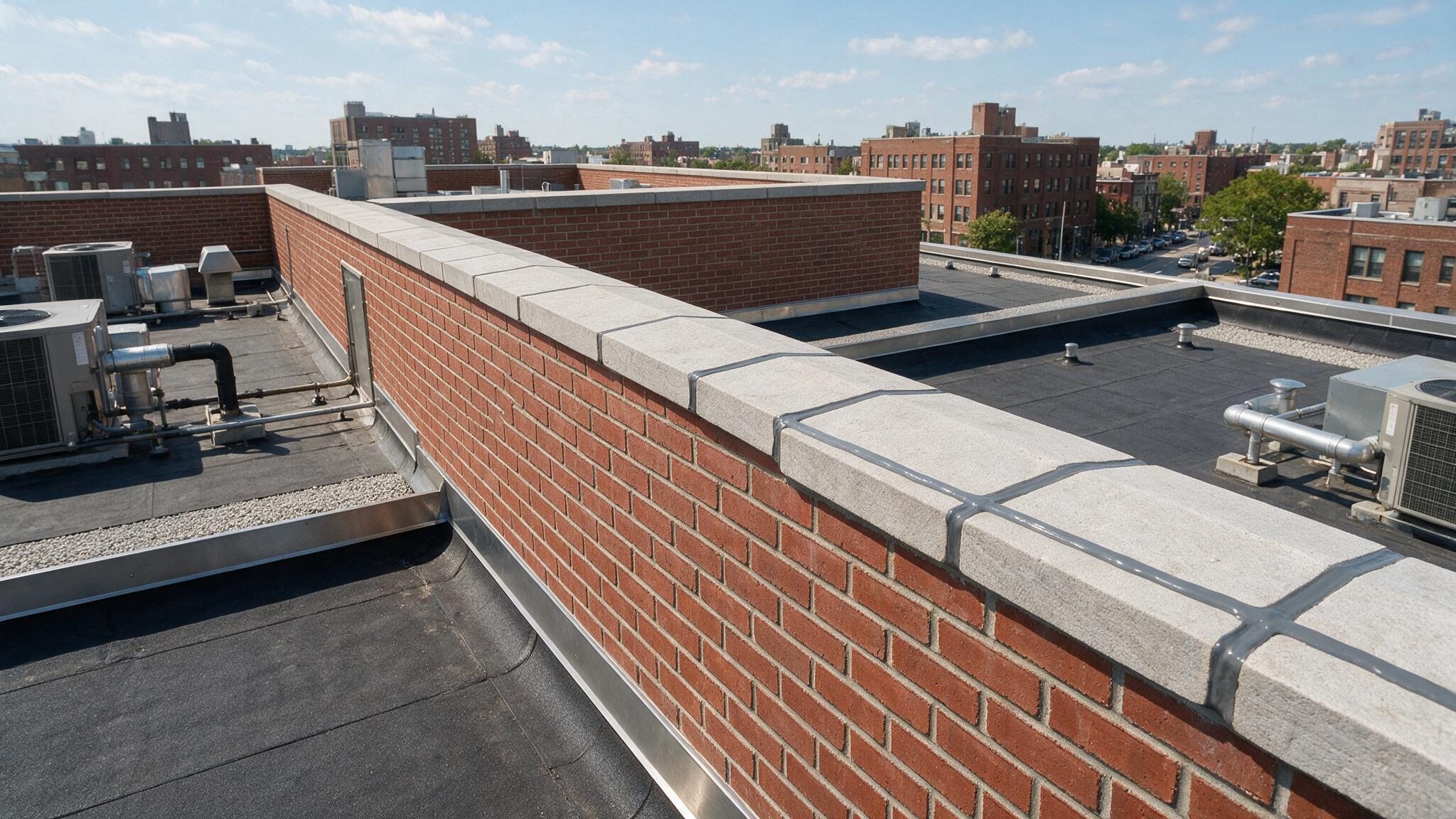
In urban neighborhoods like Strawberry Mansion, South Philadelphia, and Fishtown, attached rowhomes share architectural walls that extend above the roofline. These partition walls, known as parapet walls, provide essential fire separation between properties and create a clean architectural profile. However, because they are exposed to weather from both sides, parapet walls are vulnerable to water infiltration if they aren’t properly maintained.
Many homeowners spend thousands of dollars patching their roofing membranes, only to find their leaks persist because water is actually entering through weathered brick mortar joints or damaged coping stones on top of the parapet wall.
The Role of Coping Caps in Perimeter Waterproofing
The very top surface of a brick parapet wall is its most vulnerable point. To shield the underlying masonry from rain and snow, parapet walls are finished with protective coverings called coping caps, which are typically made of stone, terra cotta tiles, or modern bent aluminum sheet metal.
[ Rain / Snow Exposure ]
v v
+————————–+ <– Stone or Metal Coping Cap
| Sealed Expansion Joint | <– Prevents water entry between stones
+==========================+
| Brick Masonry Wall | <– Must have intact mortar joints
| |
Over time, the sealant joints between individual stone coping blocks can crack and dry out due to constant exposure to sun and frost. When these joints fail, rainwater can soak directly into the center of the brick wall, traveling downward into your home’s interior framing and bypassing your low-slope rowhome roofing system’s flashing lines entirely.
Repointing Porous Brick Mortar Joints
The vertical faces of brick parapet walls are held together by mortar joints that can break down over generations. Freezing winter temperatures cause trapped moisture within the brickwork to expand, a process that can crack the mortar and loosen bricks.
Restoring the integrity of a weathered parapet wall requires a process called repointing or tuckpointing. Technicians carefully grind out the old, crumbling mortar to a depth of about half an inch and replace it with fresh, high-performance mortar that matches the original formulation. This process seals out wind-driven rain while allowing the brick assembly to breathe, stopping moisture from migrating down into your ceiling joists.
Integrating Wall Flashings with Flat Roof Membranes
Where your flat roofing membrane meets the vertical face of a parapet wall, a durable transition must be built to keep water from getting behind the system. This transition requires installing a base flashing that extends at least eight inches up the wall surface, covered by a heavy-duty metal counter-flashing tucked into a cut masonry joint.
[Brick Wall]
| | \ <– Metal Counter-Flashing tucked into mortar joint
|===|==\
| | | <– Base Flashing membrane extends up wall
+—+–+—————————–
[ Roof Insulated Deck Membrane ]
This layered design allows the roof membrane and the brick wall to expand and contract independently during seasonal temperature shifts without tearing the waterproofing layers. A skilled roofing contractor Philadelphia team checks these flashing lines during routine roof maintenance, resealing any worn termination joints to keep the entire roof perimeter watertight.
The Benefits of Applying Breathable Masonry Water Repellents
Once your parapet wall’s mortar joints are repaired and the coping caps are sealed, applying a high-quality, breathable silane-siloxane water repellent to the brickwork provides an extra layer of protection. These clear sealers penetrate deep into the brick pores, forcing water to bead up and roll off the surface instead of soaking into the masonry.
Because these sealants are breathable, they allow any moisture vapor trapped inside the wall to escape naturally, preventing freeze-thaw damage and keeping your brick rowhome walls dry, stable, and protected for years to come.
CTA
Are you dealing with an elusive roof leak that traditional patches can’t seem to fix? Ensure your perimeter walls and coping caps are fully watertight. Contact Philly Roofing LLC today to book a specialized parapet and flashing inspection.