
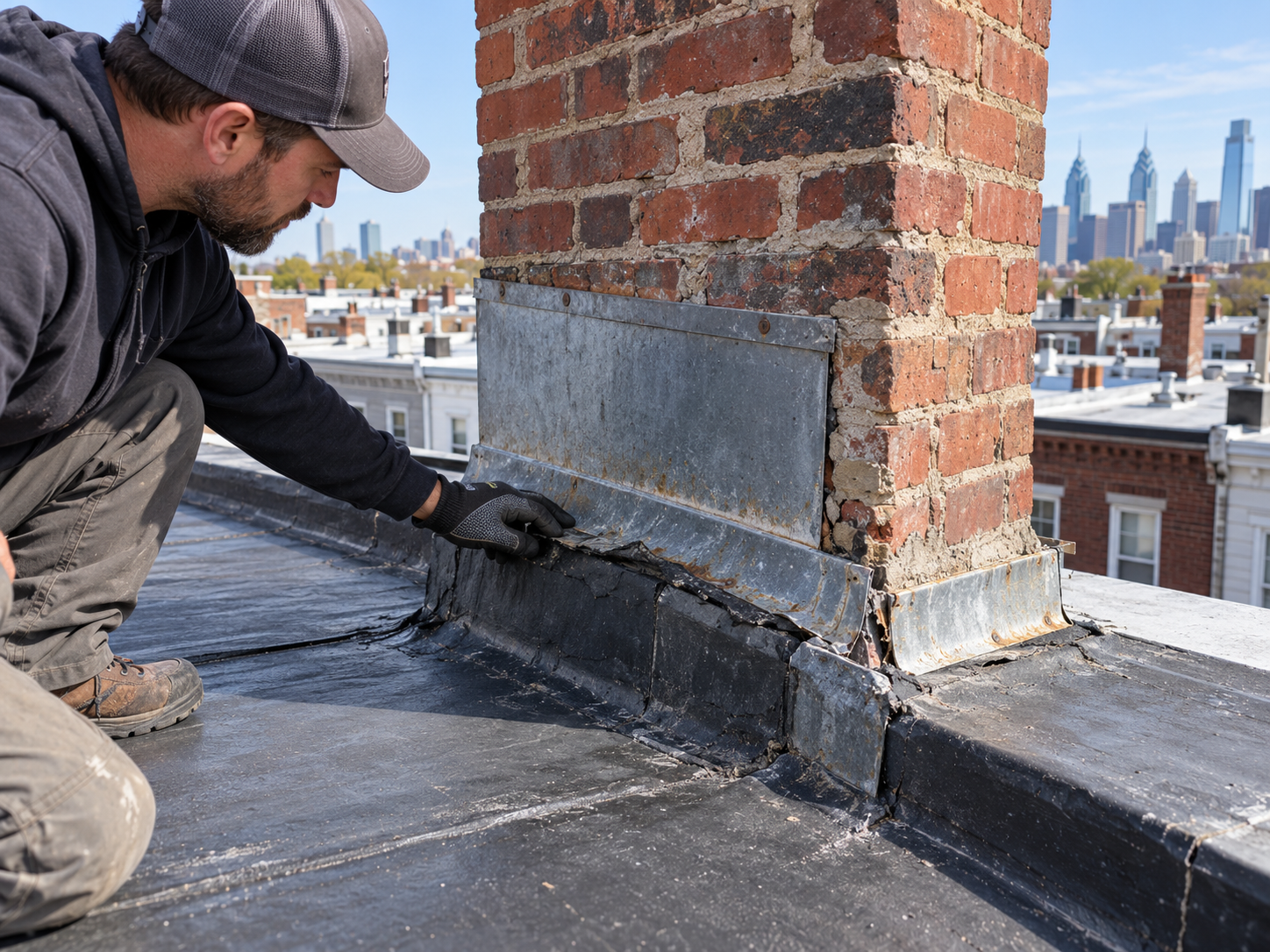
A ceiling stain near a chimney often leads homeowners to assume that water is coming directly through the masonry.
Sometimes it is.
But the transition where the roof meets the chimney is another important suspect.
This joint has to accommodate two very different building materials while directing rainwater safely onto the roof surface. When flashing is loose, corroded, poorly integrated, or patched repeatedly with roofing cement, water may travel behind the roofing system before appearing inside.
Chimney Flashing Is a System, Not a Bead of Caulk
A durable roof-to-chimney transition typically relies on overlapping components rather than surface sealant alone.
Base or step flashing integrates with the roofing material. Counter-flashing overlaps the upper portion and is detailed into or against the masonry according to the assembly.
The objective is simple: water moving down the chimney should be directed over the roofing—not behind it.
Philly Roofing’s roof repair services in Philadelphia specifically address flashing and leak-related repairs.
Why Old Flashing Starts to Fail
Philadelphia roofs experience repeated temperature changes, wind, rain, snow, UV exposure, and building movement.
Over time, metal flashing can corrode or loosen. Mortar joints holding counter-flashing may deteriorate. Previous repairs may also have covered the area with multiple layers of sealant or roof cement.
Those patches can sometimes reduce leakage temporarily, but they may also conceal the actual transition detail.
The Leak May Travel Before You See It
Water does not always drip directly beneath the exterior defect.
Once water enters a roof assembly, it can move along framing, decking, masonry, or other surfaces before reaching the visible ceiling.
That means an interior stain beside a chimney does not prove the exact exterior entry point.
A proper inspection should evaluate the chimney transition as part of the surrounding roof system.
What a Roofing Inspection Should Look For
The condition of the roofing membrane or shingles around the chimney matters, but so do the flashing terminations.
A roofer may look for open seams, deteriorated metal, loose counter-flashing, failed previous patches, damaged roofing adjacent to the chimney, and evidence that water is entering higher on the assembly.
The masonry itself may also require evaluation if joints, caps, or brick are deteriorated.
Roofing and masonry problems can occur at the same time, which is why guessing from the interior stain alone is unreliable.
Why More Roof Cement Is Not Always the Answer
Roof cement has legitimate uses in appropriate repairs, but coating every joint repeatedly is not equivalent to rebuilding a failed flashing detail.
Thick patch layers can crack, separate, trap debris, or make later diagnosis more difficult.
If the underlying metal is badly deteriorated or incorrectly installed, a repair may require removal and reconstruction of the transition.
The exact scope depends on roof type, chimney construction, access, and existing conditions.
Flat Roofs and Sloped Roofs Need Different Details
Philadelphia includes both low-slope row-home roofs and sloped shingle roofs.
A chimney penetrating a low-slope membrane roof is detailed differently from a masonry chimney intersecting asphalt shingles.
That is why repair methods should follow the actual roof assembly and compatible manufacturer or industry guidance rather than a one-size-fits-all patch.
The National Roofing Contractors Association provides roofing-industry resources for professional roof-system practices.
Address Chimney Leaks Before Interior Repairs
Painting a ceiling stain before the water-entry source is corrected only hides evidence temporarily.
If moisture continues entering, new drywall compound and paint can stain again, while concealed wood or insulation remains exposed to moisture.
The sequence should be diagnosis, exterior repair, drying and verification, and then interior restoration.
FAQ
Does water beside a chimney always mean the flashing failed?
No. Chimney masonry, caps, roofing, and other nearby details can also admit water.
Can chimney flashing be repaired without replacing the entire roof?
Often, localized repair is possible, but the scope depends on the condition of the surrounding roofing and existing flashing.
Is caulk enough for a chimney leak?
Not when the underlying flashing assembly has failed. Sealant may be part of a detail, but it should not substitute for missing or deteriorated flashing.
Why does my ceiling leak only during wind-driven rain?
Wind can push water into vulnerable joints that may not leak during lighter vertical rainfall.
If moisture is appearing near a chimney, Philly Roofing can inspect the roof-to-masonry transition and determine whether flashing, roofing, masonry, or a combination of conditions is contributing to the leak.